
How does solar net metering pakistan 2026 function under current regulations? In brief, the National Electric Power Regulatory Authority (NEPRA) continues to support bidirectional net billing for residential consumers. Furthermore, power utilities purchase surplus daytime solar energy at off-peak rates between Rs. 22 and Rs. 27 per kilowatt-hour (kWh). In contrast, evening grid consumption costs between Rs. 55 and Rs. 68 per unit during peak hours. In addition, getting a green meter requires a three-phase sanctioned connection and an AEDB-certified installer. Consequently, typical 5kW to 10kW solar setups recover their entire capital expenditure in 2.5 to 3.2 years. Moreover, pair your system with authentic components by reviewing our guide on Tier 1 solar panel prices in Pakistan.
What is Solar Net Metering Pakistan 2026?
To begin with, understanding solar net metering pakistan 2026 starts with how the grid connection interacts with your rooftop panels. Specifically, a bidirectional electricity meter tracks both imported power from your distribution company (DISCO) and exported electricity generated during bright daylight hours.
In fact, when your solar panels generate more electricity than your home consumes, the surplus units spin the meter backward. At the end of each billing cycle, your DISCO calculates your net consumption. Consequently, if you export more electricity than you import, your utility records positive energy credits on your account.
Furthermore, these accrued credits roll over to offset your winter utility bills. For instance, consumers who generate surplus power during sunny summer months use those credits when sunlight hours decrease. Therefore, net metering eliminates high electricity bills almost entirely throughout the year.
Net Metering vs Gross Metering: The 2026 NEPRA Decision
Importantly, energy debates in early 2026 revolved around whether NEPRA would transition domestic consumers from net metering to gross metering. Under gross metering, utilities purchase all your generated solar energy at a suppressed rate while charging retail prices for every unit you consume.
However, following extensive public hearings and citizen advocacy, NEPRA preserved the core net billing structure for residential installations. Nevertheless, utilities have tightened technical compliance rules. Specifically, distribution companies now strictly enforce the 80% distribution transformer capacity ceiling to safeguard local grid stability.
Official 2026 Buyback Rates & DISCO Tariff Comparison
Many consumers inquire about how much distribution companies actually pay for exported solar energy. In reality, DISCOs do not offset your bill on a 1-to-1 peak unit basis.
Instead, utility companies credit exported daytime energy at the prevailing national average power purchase price (NEPRA off-peak rate). In 2026, this rate ranges between Rs. 22.50 and Rs. 27.20 per unit across various regional distribution companies.
💡 UNDERSTANDING THE PEAK VS OFF-PEAK BILLING DYNAMICS
Crucially, daytime solar export happens during off-peak hours. Therefore, your exported units earn off-peak credits. However, when you run heavy appliances between 6:00 PM and 10:00 PM (peak hours), your utility bills you at peak rates exceeding Rs. 65 per unit. To maximize economic return, shift high-load appliances such as washing machines, water pumps, and electric irons into midday solar hours.
In addition, let us examine the latest buyback tariffs and charges across major Pakistani distribution companies:
| Distribution Company (DISCO) | Coverage Territory | Off-Peak Buyback Rate | Peak Import Tariff | Avg Application Time | Grid Stability Rating |
|---|---|---|---|---|---|
| LESCO (Lahore) | Lahore, Kasur, Okara | Rs. 23.80 / kWh | Rs. 64.50 / kWh | 40 – 60 Days | High Demand |
| IESCO (Islamabad/Rwp) | Islamabad, Rawalpindi, Attock | Rs. 24.20 / kWh | Rs. 63.80 / kWh | 25 – 40 Days | Fastest Approval |
| K-Electric (Karachi) | Karachi Metro & Hub | Rs. 25.10 / kWh | Rs. 67.20 / kWh | 45 – 70 Days | Strict Inspection |
| FESCO (Faisalabad) | Faisalabad, Sargodha, Jhang | Rs. 23.50 / kWh | Rs. 62.90 / kWh | 35 – 50 Days | Reliable Grid |
| MEPCO (Multan/South) | Multan, Bahawalpur, Sahiwal | Rs. 22.90 / kWh | Rs. 63.20 / kWh | 45 – 65 Days | Moderate Delays |
| PESCO (Peshawar) | Peshawar, Mardan, Swat | Rs. 22.40 / kWh | Rs. 61.80 / kWh | 50 – 75 Days | Transformer Checks |
Cost Breakdown for Solar Net Metering in Pakistan 2026
Beyond the cost of solar panels and inverters, homeowners must budget for government processing fees and bidirectional meter hardware. Specifically, the total cost for securing a licensed net meter ranges from Rs. 110,000 to Rs. 185,000 PKR in 2026.
Itemized Expenditure for Green Meter Installation
In general, your net metering invoice includes the following mandatory expenses:
- Three-Phase Bidirectional Green Meter: Certified meter supplied by approved manufacturers (such as MicroTech, Vertex, or Accuracy). Costs roughly Rs. 55,000 to Rs. 75,000.
- DISCO Processing & Feasibility Fee: Official utility charges for processing your file and calculating grid capacity. Typically Rs. 12,000 to Rs. 20,000.
- NEPRA Generation License Fee: Regulatory fee for issuing a formal three-year Distributed Generation License. Costs Rs. 2,000 to Rs. 5,000.
- Earthing & Grounding Certificate: Independent third-party inspection validating earth resistance under 5 ohms. Costs approximately Rs. 15,000 to Rs. 25,000.
- Engineering & Vendor Commissioning: Single-line diagram (SLD) preparation, file submission, and DISCO liaison. Usually Rs. 25,000 to Rs. 40,000.
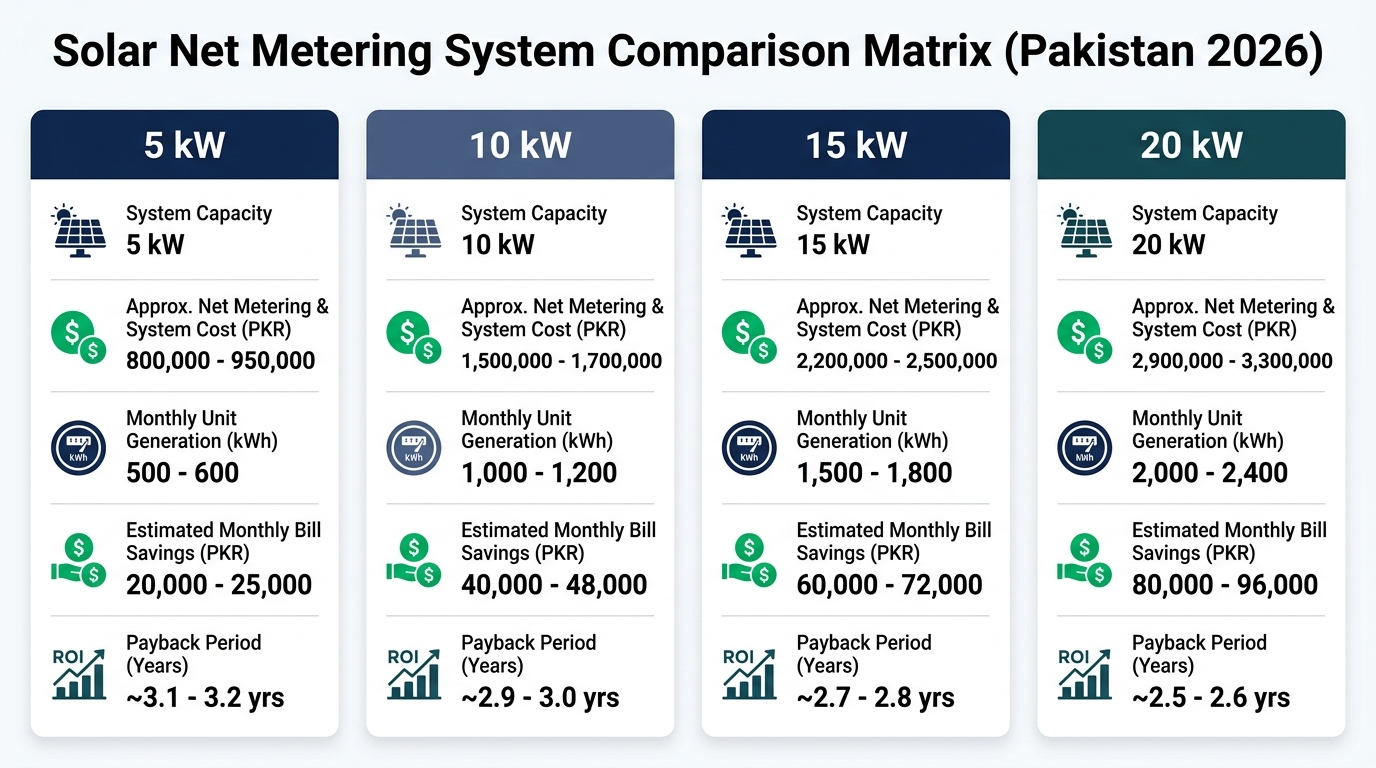
System Capacity, Capex, Monthly Generation & Payback Period
To help you select the optimal capacity for your property, review our financial matrix below:
| System Capacity | Complete Turnkey Cost | Monthly Generation | Monthly Bill Savings | Estimated Payback | Recommended Property Size |
|---|---|---|---|---|---|
| 5 kW On-Grid | Rs. 750,000 – 850,000 | 550 – 650 Units | Rs. 28,000 – 35,000 | 2.3 – 2.8 Years | 5 Marla / Small House |
| 10 kW On-Grid | Rs. 1,350,000 – 1,550,000 | 1,150 – 1,350 Units | Rs. 60,000 – 75,000 | 2.1 – 2.6 Years | 10 Marla / 1 Kanal House |
| 15 kW Hybrid/On-Grid | Rs. 2,100,000 – 2,400,000 | 1,750 – 2,000 Units | Rs. 95,000 – 115,000 | 2.4 – 2.9 Years | 1 Kanal / Commercial Office |
| 20 kW Commercial | Rs. 2,700,000 – 3,100,000 | 2,350 – 2,700 Units | Rs. 130,000 – 160,000 | 2.2 – 2.7 Years | 2 Kanal / Factory / School |
Meanwhile, if you intend to store daytime energy for load shedding protection, make sure to read our review of the top lithium solar batteries in Pakistan for high-efficiency LiFePO4 storage solutions.
Interactive Solar Net Metering Savings & Payback Calculator
Therefore, estimate your projected solar energy generation, monthly financial savings, and exact capital payback period using our dynamic simulator below:
☀️ Pakistan Solar Net Metering Generation & Payback Simulator
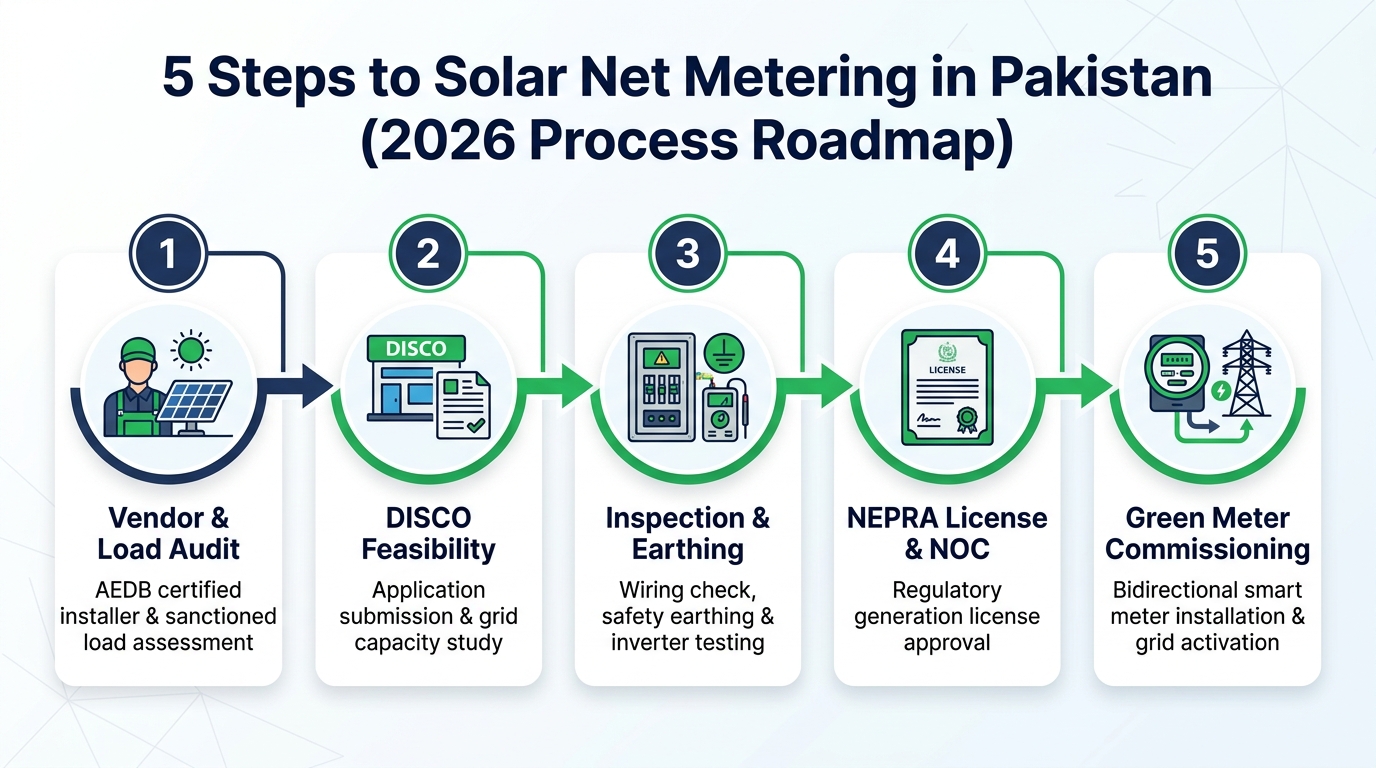
Step-by-Step Application Process for Solar Net Metering in Pakistan 2026
Overall, securing a licensed green meter involves a structured 5-stage procedure coordinated between your solar installer and your regional power utility:
Hire an AEDB / PPIB Certified Solar Vendor
First, always select a certified installer listed under AEDB category V1, V2, or V3. Uncertified contractors cannot sign your official feasibility forms. Your engineer conducts a technical site audit and assesses your rooftop azimuth.
Submit DISCO Application & Technical Load Feasibility
Next, your installer submits application Form-I to your DISCO Sub-Divisional Office (SDO). The utility evaluates your local 11kV feeder and distribution transformer capacity to ensure total solar load remains below 80%.
Perform Electrical Site Inspection & Earthing Test
Then, the DISCO technical team inspects your physical installation. They verify that your inverter has anti-islanding protection and confirm that grounding resistance tests strictly below 5 ohms.
Sign Bilateral Net Metering Agreement & Secure NEPRA License
Following successful inspection, you sign Schedule-I (Net Metering Agreement) with your DISCO. The utility then transmits your approved file to NEPRA, which issues your official Distributed Generation License.
Install Bidirectional Green Meter & Activate Reverse Billing
Finally, the metering and testing (M&T) division installs your digital bidirectional meter. They calibrate export and import registers and activate your new net billing account in the billing server.
Common Pitfalls & Why Net Metering Applications Get Delayed
Undoubtedly, unexpected delays frustrate thousands of prospective solar applicants each month. Knowing common bureaucratic pitfalls helps you avoid months of unnecessary waiting.
⚠️ CRITICAL WARNING: THE 80% TRANSFORMER CAPACITY BOTTLENECK
Under NEPRA operating codes, the total connected solar net metering capacity on any shared distribution transformer cannot exceed 80% of its rated capacity. For example, a 100 kVA transformer can host at most 80 kW of aggregate solar. If neighbors in your street have already installed 80 kW, your DISCO will reject your application until the transformer is upgraded.
Specifically, watch out for the following four major reasons for rejection or suspension:
- Sanctioned Load Discrepancy: Your solar inverter capacity cannot exceed your sanctioned grid load. If your home has a 5 kW sanctioned load, you cannot install a 10 kW net meter without first applying for an official load extension.
- Single-Phase Meter Incompatibility: Net metering exclusively functions on three-phase meters. Single-phase domestic consumers must upgrade their meter to three-phase before filing their net metering petition.
- Non-Compliant Solar Inverters: NEPRA strictly enforces grid codes requiring built-in anti-islanding protection and low-voltage ride-through (LVRT). Inverters without authentic certifications face automatic rejection. Explore compliant options in our detailed guide on the best solar inverters in Pakistan.
- Outstanding Electricity Arrears: Any unpaid utility dues or disputed electricity detection bills on your reference number freeze the net metering file instantly.
Maximizing Solar Savings with the Winter Electricity Package
Moreover, smart energy management yields even greater dividends during chilly months. In fact, consumers who balance their rooftop generation with seasonal energy initiatives enjoy rock-bottom utility bills. To discover how government seasonal tariff discounts work, read our comprehensive analysis of the Winter Electricity Package Pakistan.
Frequently Asked Questions — Solar Net Metering Pakistan 2026
In summary, investing in solar net metering pakistan 2026 remains the most profitable financial decision for residential and commercial property owners. By exporting daytime surplus electricity at Rs. 22 to Rs. 25 per unit, you insulate your family against tariff hikes and eliminate energy debt. Verify your transformer capacity early, partner with an AEDB-licensed installer, and insist on certified three-phase equipment. Also, if you plan to finance your green transition, explore our guide on the best high yield savings accounts in Pakistan to park your savings profitably.