

Getting a credit card in Pakistan has never been more accessible. With over 40 banks offering credit products and fully digital application portals now available from institutions like HBL, Meezan Bank, and UBL, you can now complete the entire process from your phone in under 30 minutes. Yet many Pakistanis still get rejected — often due to easily avoidable mistakes.
This complete 2026 guide walks you through every step of how to apply for a credit card in Pakistan — from checking your eligibility and gathering the right documents, to submitting your application online or at a branch, and what to do after you're approved.
What Is a Credit Card Application in Pakistan?
When you apply for a credit card in Pakistan, you are formally requesting a bank to extend you a revolving line of credit. The bank evaluates your financial profile — income, employment stability, existing debt, and credit history (via State Bank of Pakistan's ECIB system) — to determine whether to approve your application and at what credit limit.
Unlike a debit card, which is issued automatically when you open a bank account, a credit card requires a separate application and approval process. This process exists because the bank is effectively lending you money each time you swipe.
In Pakistan, credit card applications can be submitted through three main channels: online via the bank's website, through a mobile banking app, or in person at a branch. Some banks also accept applications via third-party financial comparison platforms.
Pakistan's State Bank of Pakistan (SBP) regulates all credit card issuance. Banks must follow SBP's Prudential Regulations when setting credit limits — typically capping them at a multiple of your verified monthly income.
Eligibility Requirements for a Credit Card in Pakistan
Before you apply, make sure you meet the basic eligibility criteria. While requirements vary slightly between banks, the following standards apply to most Pakistani credit card issuers in 2026:
Credit Card Eligibility Checklist — Pakistan 2026
Salaried Applicants
- Age: 21–60 years
- Min. income: PKR 25,000–50,000/month
- Employment: 6+ months at current job
- Pakistani national (CNIC holder)
- Clean or acceptable ECIB history
- Existing bank account preferred
Self-Employed / Business
- Age: 25–65 years
- Min. income: PKR 50,000–75,000/month
- Business operating for 2+ years
- NTN registered (preferred)
- Clean ECIB credit record
- Business bank account required
Minimum Income Requirements by Card Type
Different card tiers have different minimum income thresholds. Here's a breakdown:
| Card Tier | Min. Monthly Income | Typical Credit Limit | Example Cards |
|---|---|---|---|
| Classic / Standard | PKR 25,000 – 35,000 | PKR 30,000 – 100,000 | UBL Classic, MCB Standard |
| Gold | PKR 40,000 – 60,000 | PKR 100,000 – 300,000 | HBL Gold, Bank Alfalah Gold |
| Platinum | PKR 75,000 – 120,000 | PKR 300,000 – 1,000,000 | HBL Platinum, MCB Visa Platinum |
| Signature / World | PKR 200,000+ | PKR 1,000,000 – 5,000,000+ | SCB World, Citibank Signature |
Pakistan's Electronic Credit Information Bureau (ECIB), managed by State Bank of Pakistan, maintains a record of every loan, credit card, and repayment history in the country. A poor ECIB rating — caused by missed payments, defaults, or multiple rejected applications — is the most common reason for credit card rejection in Pakistan. Check your ECIB report before applying.
Required Documents for Credit Card Application in Pakistan
Having the right documents ready before you apply significantly speeds up the process and reduces the chances of rejection. Here is a complete list of what most Pakistani banks require:
For Salaried Employees
- CNIC — Computerised National Identity Card (front and back copy), valid and not expired
- Salary slips — Last 3 to 6 months of salary slips from your employer
- Bank statement — Last 6 months of your salary account statement showing regular credits
- Employment letter — On company letterhead, confirming your designation, salary, and tenure
- Utility bill — Recent electricity, gas, or water bill as proof of residence (some banks)
For Self-Employed / Business Owners
- CNIC — Valid national identity card
- Business registration certificate — SECP, FBR, or Chamber of Commerce registration
- NTN (National Tax Number) — Tax registration proof from FBR
- Bank statement — Last 6–12 months of business current account
- Tax returns — Last 1–2 years of filed income tax returns
- Utility bill — Business or residential address proof
Some banks like Meezan Bank and Bank Alfalah may require additional documentation or waive certain requirements for existing account holders. If you already bank with the institution, the process is often faster and more lenient.
Step-by-Step: How to Apply for a Credit Card in Pakistan
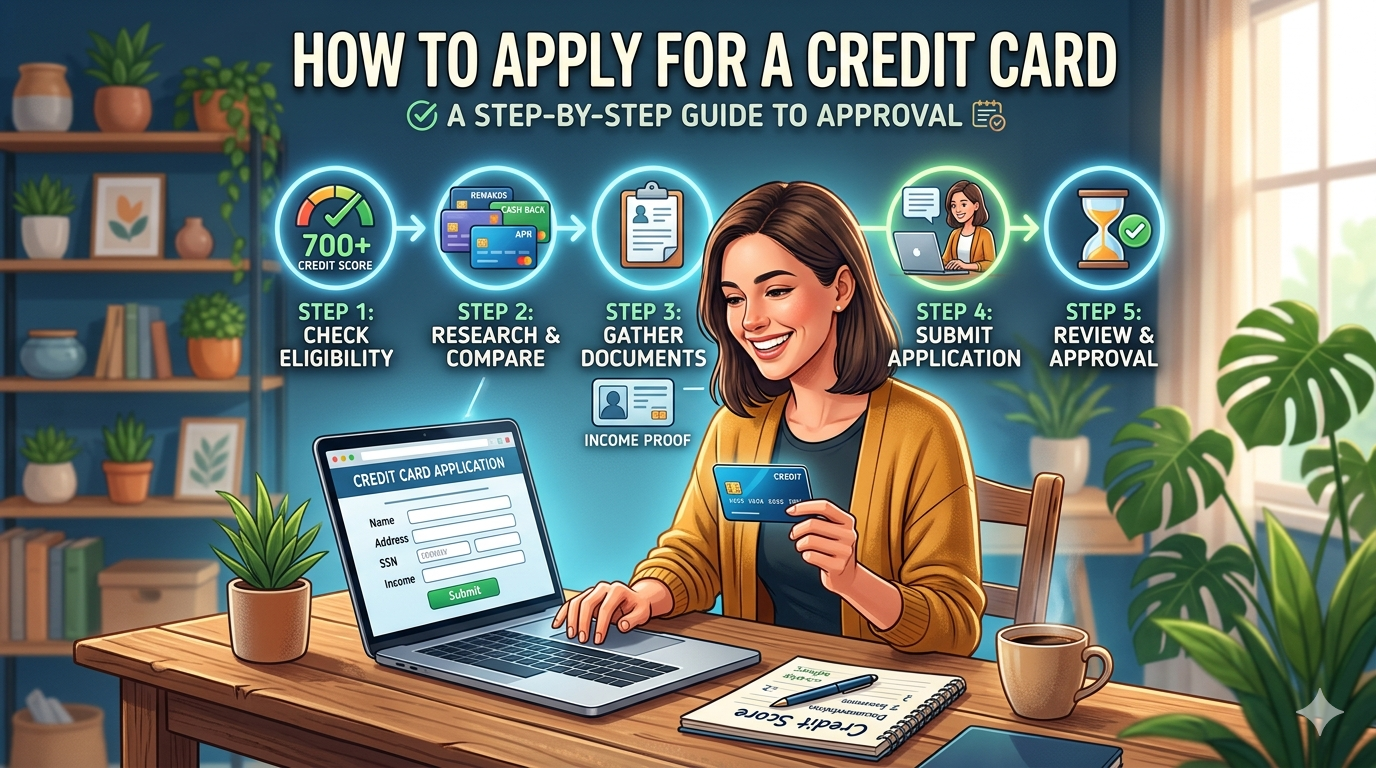
Follow these six steps to successfully apply for a credit card in Pakistan in 2026:
Before applying anywhere, assess your financial profile honestly. Confirm your monthly income meets the minimum threshold, check how long you've been employed, and verify your ECIB credit record. You can request your free annual ECIB report from any bank branch or through SBP's ECIB portal. Knowing your credit status prevents wasted applications that could further hurt your score.
Not all credit cards are created equal. Compare cards based on:
- Annual fee — ranges from PKR 0 to PKR 15,000+
- Markup rate — typically 30–42% APR; lower is better
- Rewards — cashback, points, air miles, or fuel discounts
- Perks — lounge access, travel insurance, 0% EMI offers
- Eligibility match — apply for a card you clearly qualify for
Visit the comparison section below or check the official pages of HBL, MCB, and Meezan Bank.
Use the document checklist in the section above. Ensure your CNIC is valid and not expired (check your CNIC expiry date — it must be renewed through NADRA). Salary slips should match the amount reflected in your bank statement. Discrepancies between documents are a common cause of rejection.
Choose your preferred application channel — online, mobile app, or in-branch. Fill in all personal details accurately. Double-check your CNIC number, phone number, and employer details before submitting. Any mismatch with official records can delay or reject your application. See the detailed online and branch guides in the next two sections.
After submission, the bank's risk and compliance team will verify your identity through NADRA's VERISYS system and assess your income via your documents and ECIB record. Some banks may call you for a telephonic verification. Others require a physical visit to a branch for biometric verification. Respond promptly to any bank calls — unanswered verification calls are a leading cause of application abandonment.
Upon approval, your credit card will be dispatched via courier to your registered address within 3–7 business days. You will receive a separate PIN mailer. Activate your card through the bank's mobile app, by calling the 24/7 helpline, or at any ATM. Set up SMS and email alerts immediately to monitor transactions from day one.
How to Apply for a Credit Card Online in Pakistan
Online credit card applications are now the fastest and most convenient method in Pakistan. Here is the general process, which applies to most major banks:
- Visit the bank's official website — Always use the official URL (e.g., hbl.com, mcb.com.pk). Avoid applying through unofficial third-party links to protect your personal data.
- Navigate to Credit Cards → Apply Now — Most banks have a dedicated "Cards" section in the main menu with a clear "Apply Online" button.
- Fill in the online application form — Enter your CNIC number, full name (as on CNIC), date of birth, mobile number (must match NADRA records), address, employer name, and monthly income.
- Upload scanned documents — Upload clear, legible scans or photos of your CNIC (both sides), salary slips, and bank statement. File formats are usually PDF or JPG; keep each file under 2MB.
- Submit and note your tracking number — After submission you will receive an SMS/email confirmation with an application reference number. Keep this for follow-ups.
- Complete video/telephonic KYC — Many banks now use digital KYC. You may need to do a short video call or respond to an SMS-based OTP verification.
Online Application Links — Major Pakistani Banks (2026)
| Bank | Online Application Link | Processing Time |
|---|---|---|
| HBL | hbl.com — Apply for Credit Card | 5–7 business days |
| MCB Bank | mcb.com.pk — Credit Cards | 5–10 business days |
| Meezan Bank | meezanbank.com — Islamic Cards | 7–10 business days |
| UBL | ubldigital.com — Credit Cards | 5–7 business days |
| Standard Chartered | sc.com/pk — Credit Cards | 7–10 business days |
| Bank Alfalah | alfalahghi.com — Credit Cards | 5–7 business days |
| Bank Al-Habib | bankalhabib.com — Credit Cards | 7–10 business days |
How to Apply at a Bank Branch in Pakistan
If you prefer in-person assistance, or if your bank does not yet support fully digital applications, visiting a branch is straightforward. Branch applications can sometimes be processed faster for existing customers with established relationships at that bank.
- Visit your nearest branch — Locate a branch using the bank's website branch locator. HBL has 1,700+ branches, MCB has 1,500+, and Meezan Bank has 1,000+ branches nationwide.
- Request a credit card application form — Ask at the service desk or customer care counter. Bring your original CNIC and all supporting documents.
- Fill out the form with a bank officer — Branch staff will assist you. They will perform biometric verification on the spot using NADRA's live system, which speeds up the identity-check phase.
- Submit documents and get a receipt — Hand over photocopies of all documents. The bank officer will give you a reference number and expected processing timeline.
- Follow up if needed — Call the bank's helpline or visit the branch after the stated processing period if you haven't received a response.
Existing customers with a salary account at the bank often get preferential treatment at branches. If your salary is credited to an HBL, MCB, or UBL account, applying for that bank's credit card is strongly recommended — your income is already verified through your account history, which simplifies and accelerates the process.
Top Banks — Credit Card Application Comparison (2026)
Here is a side-by-side look at how the application process and key terms compare across the best credit cards in Pakistan for 2026:
- Min. salary: PKR 40,000/month
- Online + branch application
- NADRA biometric verification
- Processing: 5–7 days
- Card delivery: 3–5 days
- App: HBL Mobile
- Min. salary: PKR 35,000/month
- Online + branch application
- Digital KYC available
- Processing: 5–10 days
- Card delivery: 5–7 days
- App: MCB Mobile
- Min. salary: PKR 25,000/month
- Online + branch + app
- Shariah-compliant process
- Processing: 7–10 days
- Card delivery: 5–7 days
- App: Meezan Bank App
- Min. salary: PKR 30,000/month
- Online + branch application
- Telephonic KYC option
- Processing: 5–7 days
- Card delivery: 3–5 days
- App: UBL Digital
- Min. salary: PKR 50,000/month
- Online + branch application
- SC Mobile app apply option
- Processing: 7–10 days
- Card delivery: 5–7 days
- App: SC Mobile Pakistan
- Min. salary: PKR 30,000/month
- Online + branch + WhatsApp
- Alfalah Islami option
- Processing: 5–7 days
- Card delivery: 3–5 days
- App: Alfalah Mobile
Guide for Self-Employed & Business Owners in Pakistan
Applying for a credit card as a self-employed individual or business owner in Pakistan is more documentation-intensive than for salaried applicants, but absolutely achievable. Here's what you need to know:
Key Differences from Salaried Applications
- Income proof is less straightforward — banks rely on bank statements and tax returns rather than salary slips
- Business age matters — most banks want 2+ years of business operating history
- Higher income threshold — typically PKR 50,000–75,000 net monthly income versus PKR 25,000–35,000 for salaried
- NTN registration strongly preferred — it demonstrates formal tax compliance and financial legitimacy
Best Banks for Self-Employed Credit Card Applicants
Meezan Bank and Bank Alfalah have historically been more flexible for self-employed applicants, particularly for business owners with established accounts. BankIslami and Dubai Islamic Bank Pakistan are also known for accommodating small business owners with Islamic card options.
After Approval: What to Expect
Getting approved is just the beginning. Here is what happens after your credit card application is approved in Pakistan:
- Approval SMS/Email — You receive immediate notification of approval with your assigned credit limit.
- Card dispatched — Your physical card is sent via courier (usually TCS or M&P) to your registered address within 3–7 business days.
- PIN mailer arrives separately — Your PIN is mailed in a separate sealed envelope for security. Some banks allow PIN generation via mobile app instead.
- Activate your card — Activate through the mobile app, call the helpline, or do a PIN-based transaction at any ATM.
- Set up alerts — Immediately enable SMS and email transaction alerts. This protects against fraud from day one.
- Understand your billing cycle — Ask the bank for your statement date and payment due date. Mark these dates in your calendar. Missing the due date even once can trigger markup charges.
Pakistani credit cards typically have a 25-day interest-free period after the statement date. For example, if your statement is generated on the 1st of each month, your payment is due around the 25th. Pay the full outstanding balance by that date and you will never pay a single rupee in markup/interest.
Why Credit Card Applications Get Rejected in Pakistan
Understanding the most common reasons for rejection helps you avoid them. According to banking insiders and credit experts, here are the top reasons Pakistani credit card applications fail:
| Rejection Reason | How to Fix It |
|---|---|
| Poor ECIB credit history | Clear outstanding dues on existing loans/cards. Wait 6–12 months before reapplying. |
| Income below minimum threshold | Apply for a lower-tier card or wait until your income increases. |
| Employment less than 6 months | Wait until you have at least 6 months of continuous employment. |
| CNIC expired or details mismatch | Renew your CNIC through NADRA before applying. |
| Too many recent applications | Each application creates an ECIB inquiry. Space applications at least 3–6 months apart. |
| Unstable salary credits in bank statement | Ensure salary is credited regularly to your account for 3+ consecutive months. |
| High debt-to-income ratio | Pay down existing loans before applying for a new credit card. |
| Incorrect or incomplete forms | Double-check all details before submission. Ask branch staff to review. |
Tips to Maximise Your Credit Card Approval Chances
Follow these expert tips to give your credit card application the best possible chance of approval in Pakistan:
- Apply with your own bank first. If your salary account is with HBL, apply for an HBL credit card. Your transaction history is already visible to them, reducing perceived risk significantly.
- Check and clean your ECIB report. Request your ECIB report before applying. Dispute any errors with the relevant bank. A clean record is the single most important approval factor.
- Apply for a card that matches your income. Applying for a Platinum card on a PKR 30,000 salary almost guarantees rejection. Match your application to your actual financial profile.
- Ensure consistent salary credits. Banks look for regular, predictable income in your bank statement. Irregular or missing salary credits raise red flags.
- Do not apply to multiple banks simultaneously. Multiple applications in a short period create multiple ECIB inquiries, which signals financial distress to lenders.
- Renew your CNIC before it expires. An expired CNIC is an automatic disqualification. Check your expiry date on the front of your card.
- Reduce your existing debt first. If you have car loans or a mortgage, pay them down to improve your debt-to-income ratio before applying for a credit card.
- Consider a secured credit card as a starting point. Some banks offer secured credit cards (backed by a fixed deposit). These are easier to obtain and help build your credit history for future unsecured products.
Final Thoughts: Applying for a Credit Card in Pakistan (2026)
Applying for a credit card in Pakistan in 2026 is easier than ever — but getting approved still requires preparation. The process is straightforward: check your eligibility, gather the right documents, choose a card that matches your income, and apply through the channel that works best for you (online is fastest).
The most important factor remains your ECIB credit history. A clean record, stable income, and matching documentation will get almost any application approved within a week. For Muslims seeking a halal option, Meezan Bank and Bank Alfalah Islami offer fully Shariah-compliant alternatives with streamlined applications.
Once you have your card, use it responsibly — pay the full balance every month, monitor transactions via SMS alerts, and you will build a strong credit history that opens the door to home loans, car financing, and premium banking products in the future.
Frequently Asked Questions (FAQs)
Most Pakistani banks require a minimum monthly salary of PKR 25,000–35,000 for a basic or classic credit card. Gold cards typically require PKR 40,000–60,000/month. Platinum cards require PKR 75,000–120,000/month. Some banks like Meezan Bank accept as low as PKR 25,000 for entry-level cards.
Yes. Most major Pakistani banks — including HBL, MCB, UBL, Meezan Bank, Standard Chartered, and Bank Alfalah — now offer fully digital online applications via their websites and mobile apps. You upload documents digitally and complete identity verification via SMS OTP or video KYC. Some banks may still require a branch visit for biometric verification.
The approval process takes 5–10 business days for most Pakistani banks. After approval, the physical card is dispatched via courier and typically arrives within 3–7 business days. Total time from application to card-in-hand: approximately 2–3 weeks. Existing customers of the same bank often experience faster processing (3–5 days).
Yes. Self-employed individuals and business owners can apply for credit cards in Pakistan. Required documents include a business registration certificate, NTN number, business bank statements (6–12 months), and tax returns. Meezan Bank and Bank Alfalah are particularly accommodating for self-employed applicants. The minimum income requirement is higher (typically PKR 50,000–75,000/month).
Conventional credit cards involve interest (riba). For Muslims, Meezan Bank, BankIslami, Bank Alfalah Islami, and Dubai Islamic Bank Pakistan offer Shariah-compliant credit cards. These operate on riba-free structures approved by a Shariah Supervisory Board. The application process is the same as conventional cards.
The Electronic Credit Information Bureau (ECIB) is Pakistan's national credit bureau, managed by the State Bank of Pakistan. It tracks every loan, credit card, and repayment history of every bank customer in the country. When you apply for a credit card, the bank pulls your ECIB report. A poor score — caused by missed payments or defaults — will lead to rejection. You can request your ECIB report for free once per year from any bank branch.
If rejected, ask the bank for the specific reason. Common reasons include low income, poor ECIB history, expired CNIC, or employment instability. Address the root cause before reapplying. Wait at least 3–6 months before submitting a new application — repeated rejections create negative ECIB inquiries that further damage your credit profile. Consider applying for a secured credit card (backed by a fixed deposit) as an intermediate step to build credit history.